


Mixed-Reality Theatre: An Ark Feels More Gadget Than Drama
A theatre-goer arriving at the Shed for An Ark is quickly told what the evening will not include: Ian McKellen will not appear in person. That message, delivered in an email reminder, frames the production before it even begins. Although the show runs for just 47 minutes, the process surrounding it is long and unusually strict. Audience members must check coats and bags, remove their shoes, and place them in a storage cubby before entering a red-carpeted seating area. The central requirement is wearing VR goggles, which turns the performance into a controlled, tech-led event rather than a typical live show.
For some, the practical demands go further. Anyone who relies on glasses and does not wear contact lenses must swap their own frames for a corrective version of the headset. That single detail may be enough to discourage certain theatre fans, especially those who already find immersive experiences uncomfortable. Even so, the production markets itself as something rare and groundbreaking, with programme notes presenting it as the world premiere of a new kind of play built specifically for mixed reality.
Whether the claim is fully provable is beside the point. What matters more is what the experiment delivers. The result is not a thrilling leap forward, but a fairly plain experience wrapped in expensive presentation. Instead of live performers, the audience watches four pre-recorded actors inside the headset: Ian McKellen, Golda Rosheuvel, Arinzé Kene, and Rosie Sheehy. They sit in a semi-circle on floating chairs, addressing the viewer directly. The writing gives them little room to become full characters. They are shaped more like moods: one warm and inviting, one calm and wise, one bright, and one edged with boredom as if impatient with the whole idea.
The situation the actors describe becomes clear without being fully stated. They are dead. The audience members are also dead, but seem to have arrived more recently, like newcomers being guided through an unfamiliar waiting room. The actors speak gently, asking the viewer not to panic or feel afraid. The concept recalls the final act of Our Town, where death is used to sharpen the meaning of everyday life. However, An Ark lacks the emotional build-up that makes that kind of reflection hit hard. With no earlier acts to give weight to the themes, the piece drifts through soft wonder until the message starts to feel repetitive.
Much of the script relies on lists of sensory memories: foods, fabrics, small objects, fleeting pleasures, and private fears. One moment celebrates pineapple juice, another lingers on old newspapers, and another names cherry blossom and chocolate milk. These lists are meant to remind the viewer what living contains, but the repeated sweetness begins to dull the impact. McKellen’s voice adds texture, yet even that cannot fully lift writing that leans so heavily on vague second-person phrasing, insisting the viewer “comes alive” to silk on skin and other familiar images.
The production team appears aware of the risk that the technology could drain warmth from the experience. In notes linked to the show, the producer emphasises that the project is not generated by AI and is intended to protect human truth rather than replace it. The stated goal is to use technology to expand theatre and film in ways that bring people closer to themselves. Yet the performance itself struggles to prove that point. The effect is less communal and more sealed-off. The audience sits in circles, tethered by headset wires, while digital figures hover just out of reach.
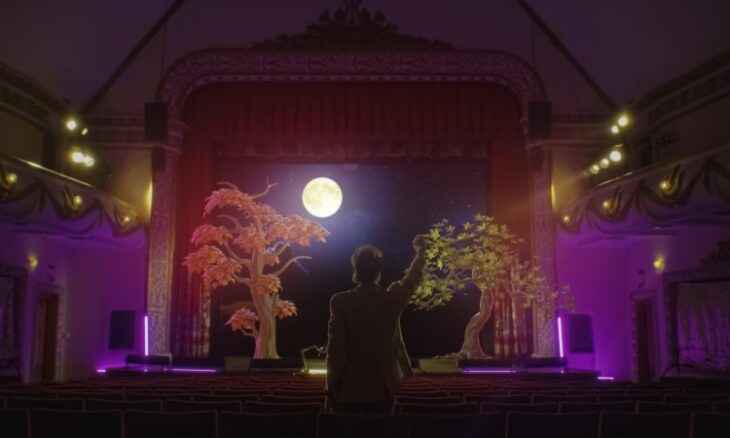
One unsettling feature of the goggles is that they do not fully block the real world. The theatre space remains visible, and the actors appear over it like holograms. This “mixed” view creates an odd layer of distance. At times, it becomes easier to watch the actual people in the room than the virtual performers floating in front of them. Rows of audience members sit with hidden eyes, plugged into machines, silent and still. The scene begins to resemble a group watching separate screens rather than sharing a live event. In that context, it is hard to feel that presence, risk, or spontaneity, the elements that often make theatre feel alive.
When the piece ends, the response is not immediate excitement. There is a pause, then applause that sounds more polite than moved. Nearby, one woman laughs uncertainly and questions what, exactly, the audience is meant to applaud. That reaction captures the wider problem: An Ark aims for emotional depth, yet feels thin, as if the technology has replaced the heartbeat.
The disappointment stands out even more in January, when New York fills with daring festival work. At the same time as An Ark, several festivals are running shows that push form and structure with far less money and far more energy. In a small converted room at Target Margin’s warehouse theatre in Sunset Park, The Mushroom by Normandy Sherwood and Nikki Calonge also asks audiences to remove their shoes. But instead of sleek digital polish, it offers a pulsing, tactile world of colour and strange, organic movement. Dancers appear as shifting creatures made from found materials, turning the room into a living forest floor. The piece brings decay and vitality into the space with force and imagination, achieving something An Ark reaches for but never fully touches.
Other festival works explore similar themes with sharper detail. One production, 2021, combines live video-game play, personal objects, and an AI model to revisit the final days of a man who faced illness, political extremism, and systemic failure. It deals in death and memory too, but with specificity rather than broad sentiment, allowing the viewer to feel the real weight of a life.
Even a cancelled project at La MaMa, disrupted by visa problems, was transformed into an unexpected celebration. Instead of a twelve-hour performance built from interviews, the creators invited dozens of workers and audience members to share lunch on stage. Printed questions on paper slips sparked conversations about funerals, needs, hopes, and whether life turned out as imagined. The event became alive through human exchange, the very thing mixed-reality work claims to protect.
Against that backdrop, An Ark feels like an impressive container carrying only a small amount of meaning. It offers careful staging, expensive headsets, famous faces, and gentle language about life. But theatre is not only about what is said. It is also about risk, friction, and the unrepeatable charge of bodies sharing a room. In chasing a new format, An Ark seems to leave those essentials behind.